LiberePassioni is a personal project dedicated to cruises, travel videos and world cruises: real experiences, images, stories, photography, sound and practical notes collected with care.
Real experienceOriginal videosPractical preparation
“There is a time to work and a time to live.”
Real experience
The story comes from real cruises, the Costa Deliziosa World Cruise and first-hand content collected along the journey.
Independent project
LiberePassioni does not sell trips, packages, excursions or products: it shares experiences, videos and practical notes.
Practical value
Ports, videos, documents, packing list, medicines, weather and practical preparation for cruise passengers.
From work to the world cruise
Photography, video and memory: the camera I use turns the journey into a story.
LiberePassioni was born from an important transition in my life: the end of my working chapter and the decision not to leave that new time empty, but to turn it into travel, storytelling and memory.
For many years, time was shaped by commitments, habits, responsibilities and deadlines. Then, almost suddenly, I found myself facing a question that only seemed simple: what should I do now with my time?
The answer did not arrive as a ready-made plan. It came slowly, as important decisions often do: first a thought, then a curiosity, then a possibility that began to feel less unreasonable.
So, after a very short break, I decided to do something many people considered almost excessive: leave for a world cruise.
It was not a simple holiday or a cruise lasting a few days, but a long, intense and completely new journey. The most curious thing is that this world cruise was also my first real cruise.
Faced with the doubts of those who wondered whether it was wise to start with such a long voyage, I chose to follow instinct, curiosity and the desire to experience time in a different way.
For me, the world cruise was not just an itinerary. It was a way to turn the page with enthusiasm, without regrets and without fear of starting again.
The ship became homeBoard rhythms, sea days and continuous port calls became a natural part of the journey.
My first cruise
For many people, starting with a world cruise could seem like a risky choice. Perhaps it was. But that is exactly why it became an extraordinary experience.
I adapted very well to the rhythm of the ship, life on board, the slow pace of navigation and the surprise of waking up each time in a different place.
I discovered cruising not with a week in the Mediterranean, but through a journey lasting months, across continents, oceans, cities, islands, deserts, great metropolises and small ports.
Little by little I understood that the journey was not only a cruise: it was a new form of freedom.
Inhabiting space, living time
An old passion returning
The world cruise taught me something that everyday life often makes us forget: space should not only be crossed. It should be explored, observed and inhabited.
In this way of looking at travel, something from my personal path also resurfaces. My classical studies left me with a habit of questioning, of paying attention to words, and of reflecting on memory, time, experience and storytelling.
For a long time, this inclination remained in the background, almost dormant beneath the urgencies of work and daily life. Then, when my working chapter closed, the new time in front of me brought back an old passion: reading, reflection and the desire to understand not only where one is going, but what it really means to live a place, cross a time and preserve a memory.
Philosophy, in this new lived time of mine, did not become an abstract exercise. It returned as a discreet companion of the journey: not to weigh down the story, but to give it depth.
Every journey, if truly listened to, raises simple and great questions at the same time: what do we see when we look? What remains of an experience? How does time change when we stop merely enduring it and try to inhabit it?
Space is not distance: it is experience
A port, a city, a desert, a coast or an island are not simply points on a map. They are not just stages of an itinerary or names to tick off a programme. They become real places only when they are lived with attention, when we allow what is in front of us to question us, when we accept slowing down our gaze.
For me, travelling does not mean consuming places. It means entering into a relationship with them.
Every space has its own voice: sometimes clear, sometimes hidden. Some places speak through the grandeur of the landscape, others through the smallest details: a side street, a light on the sea, the outline of a mountain, the movement of a crowd, the silence of a desert, a ship moving away from the pier.
On a journey, space stops being distance and becomes experience. Being physically present in a place is not enough to have truly lived it. One has to look, listen and pass through it consciously.
The ship as a moving home
The ship, paradoxically, helped me understand this idea better. Although it was constantly moving, it became home: a temporary, moving home, facing a different horizon every day.
A home made of routes, waiting, sea days, continuous port calls, familiar faces, new habits and small daily rituals. From that moving home I learned to look at the world not as a sequence of destinations, but as a succession of experiences to inhabit.
Even a sea day, which to some may seem like an empty interval between two ports, became part of the journey for me: a space for thought, breathing and observation. The sea, when it is not just a background, teaches slowness.
Lived time, not endured time
Time, too, changed meaning during the world cruise. In everyday life, time often passes through us without our noticing: days, weeks and years go by; we work, run, answer commitments and look at the clock.
On a journey, however, time can return to being lived. It is no longer only a calendar, a programme, a departure time or a deadline to be back on board. It becomes waiting, discovery, memory and emotion.
Clock time is the same for everyone, made of minutes and hours. Lived time, instead, changes intensity: an hour may pass without leaving a trace, or it may remain impressed forever.
There are very long days that seem short in memory, and very brief moments that remain immense: the first glimpse of a long-awaited place, the crossing of an ocean, a special dinner, a scenic flight, a road walked without hurry, a conversation on board, a particular light at sunset.
That is why I believe travel should teach us not simply to be crossed by time. To be crossed by time means letting it pass without noticing. To live time, instead, means entering into it, giving presence to the days and recognising the value of what is being lived while it is being lived.
There is a time to work and a time to live. For me this sentence is not a slogan: it has become the meaning of a transition, a choice and a new way of looking at the world.
Excursions, enthusiasm and unusual experiences
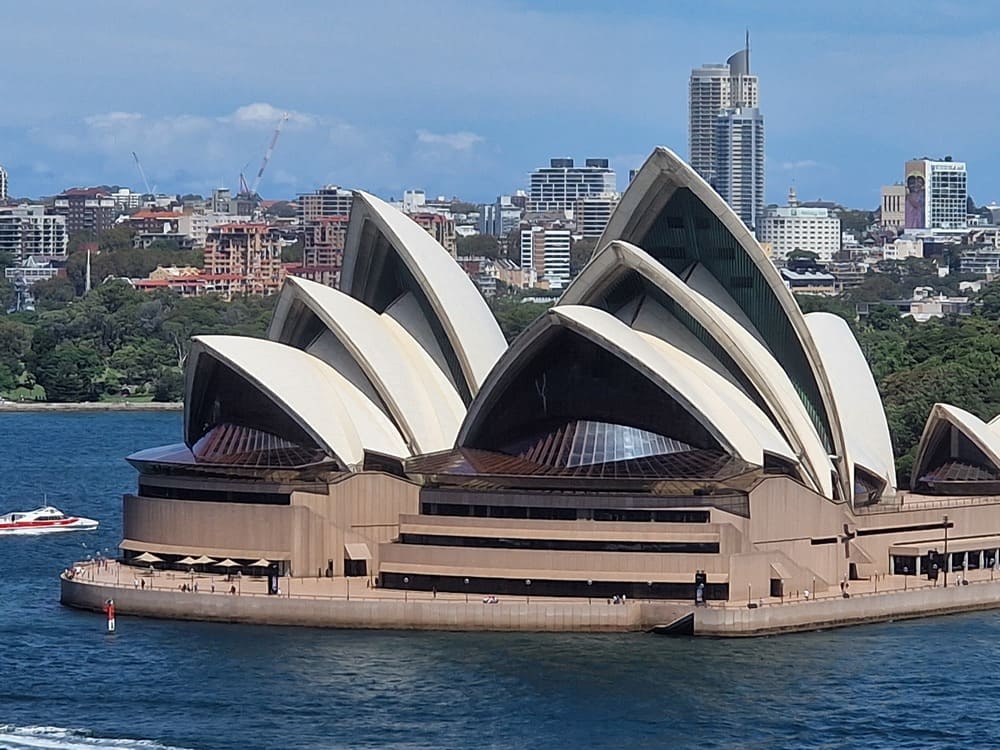
Sydney: one of the places where the cruise becomes memory, image and lived experience.
During the world cruise I experienced the ports with great enthusiasm. I did not simply look at places from a distance: I tried to live them, film them, photograph them and take them with me.
There were organised excursions, independent outings, intense days and also a few slightly daring experiences, the kind that remain vivid precisely because they do not belong to ordinary routine.
Among the most special moments were the scenic flights: helicopter flights over spectacular landscapes and the Piper flight over the Namib Desert, one of the strongest and most evocative experiences of the journey. Flying above the desert, seeing the dunes, the dry expanses and the unreal colours of Namibia from above was something difficult to describe with words alone.
In those moments I truly felt the power of space: not space measured in kilometres, but the kind of space that makes you feel small and, at the same time, incredibly alive.
Other special memories are connected with very different experiences, such as the New Year’s Eve dinner in Rio de Janeiro at a famous resort: a particular, intense and festive evening in one of the symbolic cities of the journey and of the collective imagination.
Photography, video and 360°: memory that continues
A 360° capture does not preserve only one frame: it keeps a space open to new viewpoints.
Photographs, videos and above all 360° recordings made the idea of inhabiting space and living time even stronger.
At first I thought I was filming and photographing to preserve memories. Then I realised I was doing something different: I was building a visual memory of the journey, a memory that was not closed, but still explorable.
A photograph chooses a point of view. A traditional video tells what, in that moment, one decides to frame. A 360° recording, instead, preserves a wider space around itself: it does not bring home only an image, but an environment.
This changes the way memory works. In post-production I can return inside a scene, choose a different field of view, focus on a detail I had not considered at the time, discover a side perspective, a presence in the background, a movement, a light, a detail that I had not noticed even while I was there.
It is as if the journey continued. The place does not remain fixed in the past: it can be seen again, questioned and explored once more. Lived space becomes rediscovered space; elapsed time becomes reopened time.
During the journey, the human gaze is always limited. We are there, but we cannot see everything. Emotion, the short time of a port call, heat, tiredness, curiosity and the thought of returning on board all influence what we perceive.
Watching a 360° recording again means returning to that same place with another time: slower, more reflective, freer. Post-production thus becomes a second form of travel.
It is not only a technical edit. It is a rereading of the experience. It is the moment when I choose from which angle to tell a place, which detail to enhance, which perspective to share with those who watch.
Sometimes the most interesting scene is not the one in front of me, but the one beside me. Sometimes the truest detail is at the edge. Sometimes a place reveals itself better afterwards, when immediate emotion has given way to understanding.
During the world cruise I stored more than 4 terabytes of photo and video material. Only part of it has been published: many images and recordings still have much to tell.
For this reason, LiberePassioni is not only a travel storytelling website. It is also a living visual archive: a place where images, videos, 360° footage, notes and sensations continue to speak to one another.
Why this website was created
A living archive, easy to browse on smartphone, computer, tablet and home TV.
LiberePassioni was born from a simple idea: a journey like a world cruise should not remain locked inside a phone or lost in disordered folders.
After returning, I realised I had collected much more than photos and videos: departures, oceans, ports, life on board, excursions, encounters and small moments that deserved to become an ordered and accessible story.
The website gives shape to this archive. Photos, videos and notes can be revisited as a journey, not as scattered files: from a phone, a computer, a tablet or even a TV at home.
The website is not a tourist catalogue and does not replace official sources, cruise companies or specialised operators.
LiberePassioni does not sell packages, excursions, trips, products or services. It is a personal, free and independent project, built to share a real experience, visual memories and practical notes with those who love travelling and preparing carefully.
An important part of LiberePassioni is dedicated to the world cruise, ports, itineraries and excursions. The pages devoted to port calls are not meant to be simple lists of places to visit.
The aim is to help those who are leaving to orient themselves better: understand what to see, what to photograph, which distances to evaluate, how to organise themselves, what to pay attention to and which practical aspects should not be overlooked.
After experiencing a world cruise aboard Costa Deliziosa, I understood how important it is to arrive prepared. A port call may last only a few hours, but it can leave a very strong memory when approached with the right information.
✓ Ports and excursions
✓ Documents and visas
✓ Long-cruise packing list
✓ Medicines and preparation
✓ Ship position and weather
✓ Real videos and stories
Video and visual storytelling
Through the LiberePassioni YouTube channel, travels become images, sounds, ports, departures, arrivals, landscapes, life on board and real moments.
The website and the YouTube channel work together: on one side the written and practical story, on the other the images of the journey. Those who arrive on LiberePassioni can read, watch, compare and prepare better.
Visual storytelling is not only a way to show beautiful places. It is a way to preserve what travel leaves behind: wonder, details, perspectives, memory and the desire to see the world again with new eyes.
A community of cruise passengers
LiberePassioni is also a meeting point. Alongside the website and the YouTube channel, the community helps travellers exchange ideas, questions, memories and practical preparation notes.
The complete LiberePassioni song accompanies the spirit of the project: travel, cruises, images and the world cruise told with passion.
To listen to the sound, press play.
What you can find on LiberePassioni
LiberePassioni organizes travel stories, cruises, videos, photographs and practical notes. The heart of the project remains the World Cruise, but around that story there is also preparation, travel gear, life on board, ports, excursions, community and the original sound of the site.
Real cruisesPersonal stories, practical observations and an organized memory of the journeys.
World Cruise videos and archiveFilms, playlists, unreleased videos and content organized to find places and moments easily.
Practical preparationLuggage, medicines, visas, costs, drink packages, cabin kit and useful tools before departure.
Photos, sound and personal passionsPhotography, filming, compact gear, original music and a personal travel narrative.
Last update: 10/08/2026
Perché LiberePassioni: crociere, video e Giro del Mondo
Follow LiberePassioni on YouTube
Videos, cruises, ports and stories from the World Cruise.
Abbiamo rivisitato l'intero sito: pagine aggiornate e riorganizzate e, in molti casi,
ampliate con nuove informazioni, approfondimenti e strumenti utili.
Il cuore di LiberePassioni
Ricordi personali, esperienze, fotografie e video
LiberePassioni nasce prima di tutto come luogo in cui conservare e condividere i ricordi dei viaggi vissuti.
Questa parte personale resta distinta dagli hub delle compagnie ed è il cuore del sito.
EsperienzeFotografieVideoRicordi di viaggio
Due percorsi separati
Due hub distinti, dentro un solo LiberePassioni
Separati quando serve, collegati quando è utile.
Hub Costa
Costa Crociere
Uno spazio separato, completo e approfondito, dedicato al Mondo Costa.
Hub MSC
MSC Crociere
Uno spazio separato, completo e approfondito, dedicato al Mondo MSC Crociere.
Guide e servizi comuni: quando un argomento riguarda entrambe le compagnie, i due hub si incontrano con confronti pratici per capire subito differenze, regole e punti di contatto.
L'ultima creatura
Compagni di Rotta
Completamente rivisto per essere più semplice da usare: uno spazio per chi parte per la stessa crociera e vuole organizzarsi,
scambiarsi informazioni e condividere escursioni, trasferimenti, taxi e attività.